Python Create a Continuous Running Process
· 8 min read · Updated jun 2022 · General Python Tutorials
Disclosure: This post may contain affiliate links, meaning when you click the links and make a purchase, we receive a commission.
Monitoring operating system processes enables us to monitor and display process activity in real-time. I n this tutorial, you will learn how to retrieve information on running processes in the operating system using Python, and build a task manager around it!
Now you're maybe thinking about creating something like this:
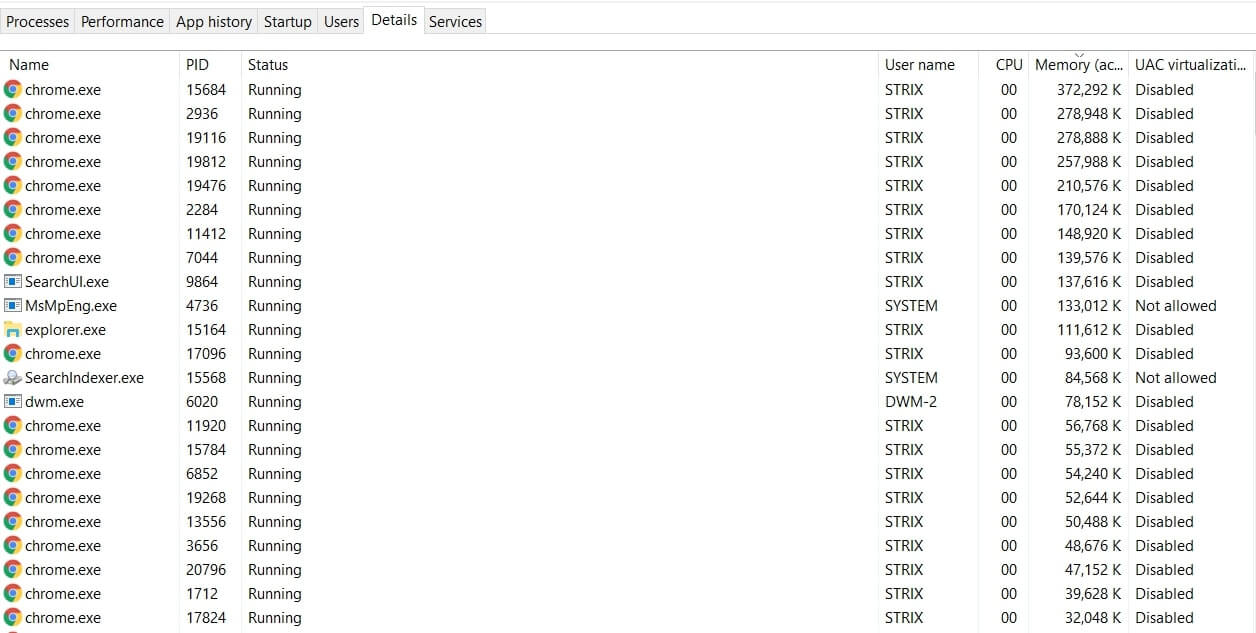
Well, not exactly, we gonna make a command-line version of this, the final script output will be this:
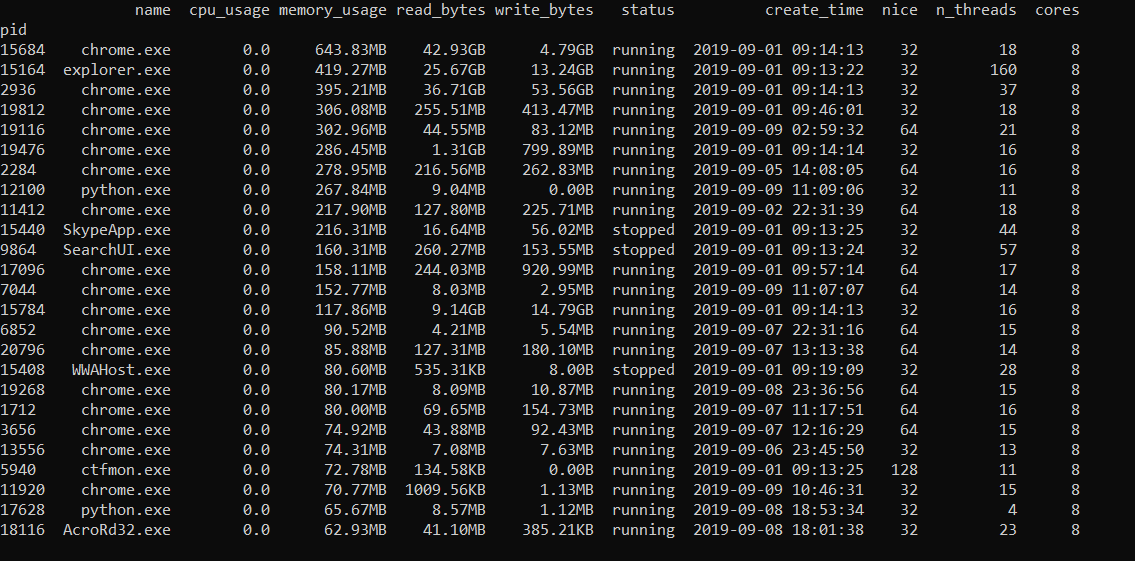
However, if you are a GUI programmer, you can make this a lot better with your own design and compete with Windows Task Manager!
Related:How to Handle Files in Python using OS Module.
Alright, now let's get into building this. First, let's install the dependencies:
pip3 install psutil pandas Open up a new Python file and import the necessary modules:
import psutil from datetime import datetime import pandas as pd import time import os We'll use the psutil as it is a cross-platform library for retrieving running processes information in Python.
The reason that we need pandas here is that after retrieving processes information, we gonna need to sort by columns and print in a tabular way.
Now, we need a way to retrieve all processes in a loop. Luckily for us, there is the psutil.process_iter() function which returns a generator yielding a process instance for all running processes in the operating system.
Let's build the core function that returns all process information, w e gonna store all the processes in a list of dictionaries, so it can be easy later on to convert it to a dataframe:
def get_processes_info(): # the list the contain all process dictionaries processes = [] Let's start the loop and iterate over the generator:
for process in psutil.process_iter(): # get all process info in one shot with process.oneshot(): # get the process id pid = process.pid if pid == 0: # System Idle Process for Windows NT, useless to see anyways continue As you may notice, I have eliminated the PID of 0, which is the System Idle Process that is for Windows NT, it has no useful information anyways.
The process.oneshot() helps us retrieve process information efficiently (faster way), we already got the pid, let's get the process name:
# get the name of the file executed name = process.name() Retrieving the time when the process was created in timestamp, as a result, we'll convert to a proper Python datetime object:
# get the time the process was spawned try: create_time = datetime.fromtimestamp(process.create_time()) except OSError: # system processes, using boot time instead create_time = datetime.fromtimestamp(psutil.boot_time()) Let's get the process CPU usage as well as the number of cores that can execute this process:
try: # get the number of CPU cores that can execute this process cores = len(process.cpu_affinity()) except psutil.AccessDenied: cores = 0 # get the CPU usage percentage cpu_usage = process.cpu_percent() Note: cpu_affinity() method only works for Linux, Windows, and FreeBSD, so if you're using another OS such as MacOS, you should comment the above code.
The reason I wrapped process.cpu_affinity() in a try/except block is that sometimes it will raise a psutil.AccessDenied for system processes (make sure you run Python as an administrator).
The process.cpu_percent() method returns a float representing the current process CPU utilization as a percentage. It compares process times to system CPU times elapsed since the last call, returning immediately. That means that the first time this is called it will return 0.0.
Getting the status of the process, whether it is running, sleeping, etc:
# get the status of the process (running, idle, etc.) status = process.status() Process priority:
try: # get the process priority (a lower value means a more prioritized process) nice = int(process.nice()) except psutil.AccessDenied: nice = 0 Memory usage:
try: # get the memory usage in bytes memory_usage = process.memory_full_info().uss except psutil.AccessDenied: memory_usage = 0 Total written and read bytes by this process:
# total process read and written bytes io_counters = process.io_counters() read_bytes = io_counters.read_bytes write_bytes = io_counters.write_bytes Total threads spawned:
# get the number of total threads spawned by this process n_threads = process.num_threads() Finally, the user that spawned that process:
# get the username of user spawned the process try: username = process.username() except psutil.AccessDenied: username = "N/A" Let's add all this information to our list and get out of the loop and return it:
processes.append({ 'pid': pid, 'name': name, 'create_time': create_time, 'cores': cores, 'cpu_usage': cpu_usage, 'status': status, 'nice': nice, 'memory_usage': memory_usage, 'read_bytes': read_bytes, 'write_bytes': write_bytes, 'n_threads': n_threads, 'username': username, }) return processes Notice that there isn't network usage information on each process, that's because psutil does not provide this information. If you want to get it, then check this tutorial to get network usage on each process by combining Scapy and psutil libraries.
As mentioned earlier, we go nna convert the processes list into a pandas.DataFrame , as a result, the following function takes the previous processes list and converts it to a dataframe :
def construct_dataframe(processes): # convert to pandas dataframe df = pd.DataFrame(processes) # set the process id as index of a process df.set_index('pid', inplace=True) # sort rows by the column passed as argument df.sort_values(sort_by, inplace=True, ascending=not descending) # pretty printing bytes df['memory_usage'] = df['memory_usage'].apply(get_size) df['write_bytes'] = df['write_bytes'].apply(get_size) df['read_bytes'] = df['read_bytes'].apply(get_size) # convert to proper date format df['create_time'] = df['create_time'].apply(datetime.strftime, args=("%Y-%m-%d %H:%M:%S",)) # reorder and define used columns df = df[columns.split(",")] return df The above function doesn't only convert that list into a dataframe, it does many other things:
- It sets the index of each row in the dataframe as the process id (as it is the unique identifier).
- It sorts the rows by the column
sort_bythat will be passed as command-line arguments (we'll get into it). - Since we need a good way to print bytes, it applies
get_size()function (which we'll declare in a moment) that converts a bunch of big numbers into a bytes format (such as 54.4MB, 103.3KB, etc.) - It also formats the
create_timeas a readable date.
Here is the get_size() function:
def get_size(bytes): """ Returns size of bytes in a nice format """ for unit in ['', 'K', 'M', 'G', 'T', 'P']: if bytes < 1024: return f"{bytes:.2f}{unit}B" bytes /= 1024 Now let's do some command-line argument parsing:
if __name__ == "__main__": import argparse parser = argparse.ArgumentParser(description="Process Viewer & Monitor") parser.add_argument("-c", "--columns", help="""Columns to show, available are name,create_time,cores,cpu_usage,status,nice,memory_usage,read_bytes,write_bytes,n_threads,username. Default is name,cpu_usage,memory_usage,read_bytes,write_bytes,status,create_time,nice,n_threads,cores.""", default="name,cpu_usage,memory_usage,read_bytes,write_bytes,status,create_time,nice,n_threads,cores") parser.add_argument("-s", "--sort-by", dest="sort_by", help="Column to sort by, default is memory_usage .", default="memory_usage") parser.add_argument("--descending", action="store_true", help="Whether to sort in descending order.") parser.add_argument("-n", help="Number of processes to show, will show all if 0 is specified, default is 25 .", default=25) parser.add_argument("-u", "--live-update", action="store_true", help="Whether to keep the program on and updating process information each second") # parse arguments args = parser.parse_args() columns = args.columns sort_by = args.sort_by descending = args.descending n = int(args.n) live_update = args.live_update If you're not familiar with Python's argparse built-in module, it allows us to easily parse arguments passed from the command line (i.e terminal).
We added a bunch of arguments, such as columns to show, sort_by column that we'll sort by in the dataframe, the number of processes to show, and live_update which is responsible for whether you want to keep the program running and continuously updating and printing process information each time (like top command in Linux).
Finally, let's call the functions we made and show the dataframe:
# print the processes for the first time processes = get_processes_info() df = construct_dataframe(processes) if n == 0: print(df.to_string()) elif n > 0: print(df.head(n).to_string()) # print continuously while live_update: # get all process info processes = get_processes_info() df = construct_dataframe(processes) # clear the screen depending on your OS os.system("cls") if "nt" in os.name else os.system("clear") if n == 0: print(df.to_string()) elif n > 0: print(df.head(n).to_string()) time.sleep(0.7) I'm using the head() method here which prints the first n rows.
Now, to execute this, you should run it as an administrator to get information about system processes as well, here is a sample output from my Linux box:
[email protected]:~/pythonscripts# python3 process_monitor.py --columns name,cpu_usage,memory_usage,status -n 20 --sort-by memory_usage --descending name cpu_usage memory_usage status pid 1312 mysqld 0.0 144.63MB sleeping 915 gnome-shell 0.0 81.00MB sleeping 3214 python3 0.0 58.12MB running 1660 rtorrent main 0.0 35.84MB sleeping 2466 rtorrent main 0.0 24.02MB sleeping 3186 php 0.0 19.58MB sleeping 737 Xorg 0.0 15.52MB sleeping 1452 apache2 0.0 12.18MB sleeping 872 teamviewerd 0.0 11.53MB sleeping 974 gsd-color 0.0 8.65MB sleeping 553 NetworkManager 0.0 7.71MB sleeping 1045 colord 0.0 7.16MB sleeping 982 gsd-keyboard 0.0 6.23MB sleeping 969 gsd-clipboard 0.0 6.09MB sleeping 548 ModemManager 0.0 5.68MB sleeping 986 gsd-media-keys 0.0 4.94MB sleeping 1001 gsd-power 0.0 4.72MB sleeping 962 gsd-xsettings 0.0 4.59MB sleeping 1023 gsd-wacom 0.0 4.40MB sleeping 961 packagekitd 0.0 4.31MB sleeping And there we go! We are done with this, as discussed above, you can make a GUI version of this, with buttons to kill, suspend, and resume the process as there are already available functions for that (process.kill(),process.suspend() and process.resume()).
There is also other information you can retrieve that is not discussed here, type help(psutil.Process) for all available fields and methods, or check their official documentation.
Check the full code here.
Also, you can use psutil to retrieve general system and hardware information.
Finally, if you're a beginner and want to learn Python, I suggest you take thePython For Everybody Coursera course, in which you'll learn a lot about Python, good luck!
Learn also:How to Convert Python Files into Executables.
Happy Coding ♥
View Full Code
Read Also

Comment panel
Source: https://www.thepythoncode.com/article/make-process-monitor-python
0 Response to "Python Create a Continuous Running Process"
Post a Comment